

Rich History of Shivamogga
Shivamogga, the gateway to Karnataka’s Malnad region, has a history that dates back thousands of years. Archaeological discoveries around the district reveal evidence of Stone Age, Neolithic and Iron Age settlements, showing that the region has been inhabited since ancient times. The name Shivamogga is traditionally associated with Lord Shiva, with interpretations including Shiva-Mukha and Shivana-Mogge. The region was also historically known as Mandli, while “Shimoga” became a commonly used anglicised form.
Over the centuries, Shivamogga came under the influence of several important South Indian dynasties, including the Mauryas, Kadambas, Western Gangas, Chalukyas, Rashtrakutas and Hoysalas. The historic town of Balligavi, once an important cultural and religious centre, flourished during the medieval period and became associated with renowned figures such as Allama Prabhu and Akka Mahadevi.
The region later became part of the Vijayanagara Empire, after which the powerful Keladi Nayakas emerged and established Keladi as their capital, later moving their centres to Ikkeri and Bednur (Nagara). Rulers such as Shivappa Nayaka strengthened the kingdom through military expansion and effective administration, while Rani Chennamma of Keladi became renowned for her courage and leadership. Historic landmarks such as the Aghoreshvara Temple at Ikkeri, Keladi temples and Shivappa Nayaka Palace continue to preserve this remarkable heritage.
Following the decline of the Keladi kingdom, the region came under Mysore rule under Hyder Ali and subsequently experienced administrative and economic changes during the colonial period. After Indian independence, Shivamogga developed into an important administrative, agricultural, industrial and educational centre. Today, the district beautifully combines its ancient heritage, temples, forests, waterfalls, coffee and arecanut plantations, rivers and modern urban development, making Shivamogga a distinctive part of Karnataka’s cultural and natural landscape.

District Overview – Shivamogga
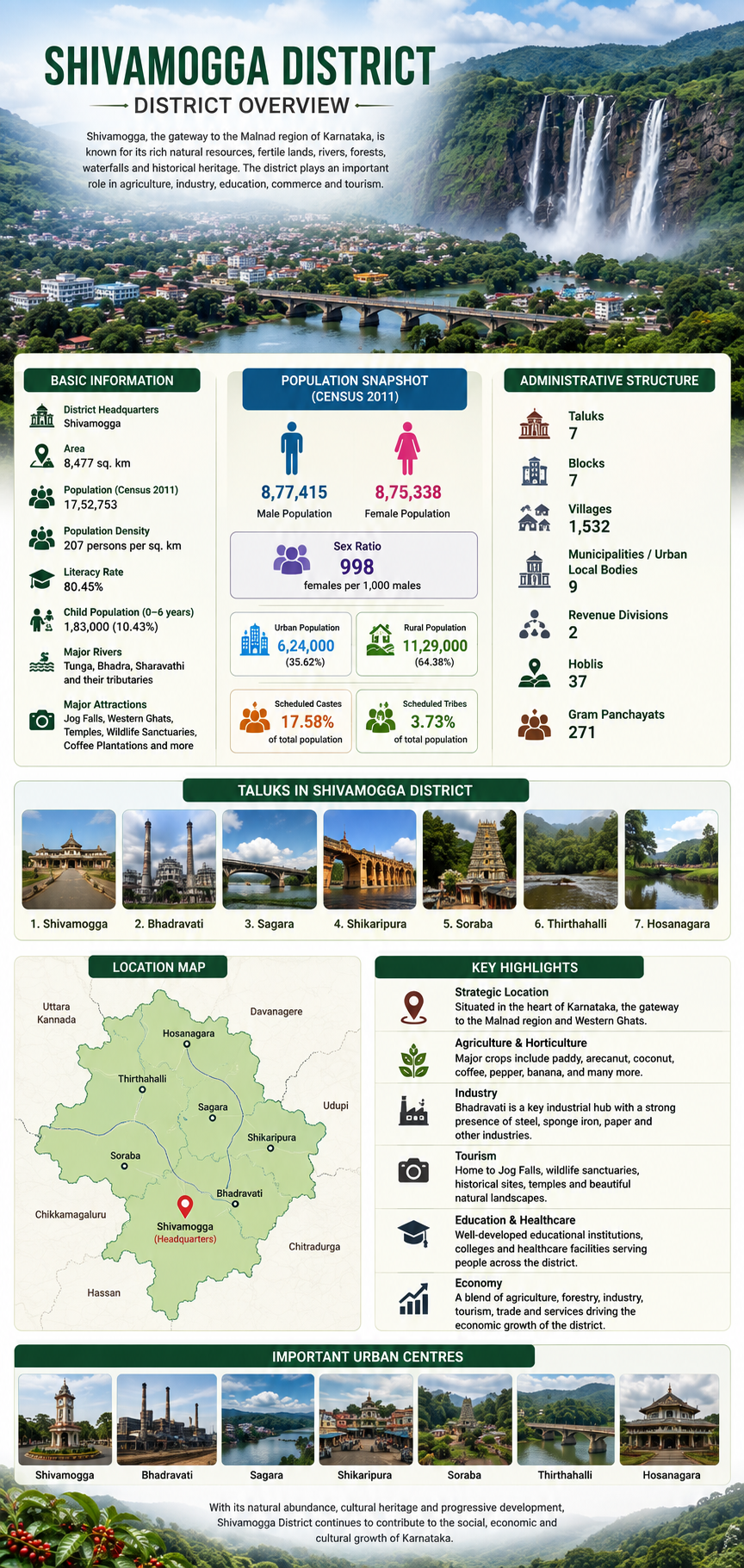
Shivamogga District, located in the central part of Karnataka, is one of the important districts of the Malnad region and is widely known for its rich natural resources, fertile agricultural lands, forests, rivers, waterfalls and historical heritage. The district covers an area of approximately 8,477 sq. km and has Shivamogga city as its administrative headquarters. According to the 2011 Census, the district had a population of 17,52,753, while the latest district administration portal continues to use this Census population figure. The district has a population density of roughly 207 persons per sq. km and a literacy rate of 80.45%, reflecting its strong educational and social development.
The district’s population comprises approximately 8,77,415 males and 8,75,338 females, giving a sex ratio of about 998 females for every 1,000 males. Around 6.24 lakh people lived in urban areas and approximately 11.29 lakh lived in rural areas according to the 2011 Census, demonstrating the district’s strong rural character alongside its growing urban centres. Children in the 0–6 age group accounted for approximately 1.83 lakh people, or 10.43% of the total population. Scheduled Castes constituted about 17.58% of the population, while Scheduled Tribes accounted for approximately 3.73%.
Administratively, Shivamogga District is divided into seven taluks: Shivamogga, Bhadravati, Sagara, Shikaripura, Soraba, Thirthahalli and Hosanagara. These taluks together cover a diverse landscape ranging from urban settlements and industrial centres to forested Western Ghats, agricultural villages and plantation areas. The district administration’s current portal lists 7 blocks, 1,532 villages and 9 municipalities/local urban bodies. Older district statistical records also refer to 2 revenue divisions, 37 hoblis and 271 Gram Panchayats; because administrative figures can change over time, the latest district portal figures should be preferred for the website.
Shivamogga has a predominantly rural economy supported by agriculture, horticulture, arecanut cultivation, paddy, coconut, coffee plantations, forestry and related activities, while Bhadravati has historically contributed to the district’s industrial development. The district’s location along the Tunga, Bhadra and Sharavathi river systems and its proximity to the Western Ghats give it exceptional ecological importance. Its landscape includes dense forests, wildlife habitats, coffee estates, agricultural fields and spectacular waterfalls such as Jog Falls, making tourism an increasingly important part of the local economy.
The district is also an important centre for education, healthcare, commerce, government administration and regional transportation. Shivamogga city serves as the principal urban and administrative centre, while Bhadravati, Sagara, Shikaripura, Soraba, Thirthahalli and Hosanagara serve as important taluk-level centres. With its combination of natural wealth, agricultural strength, educational institutions, industries, historical monuments and culturally diverse communities, Shivamogga continues to play an important role in the economic, social and cultural development of Karnataka.
Weather & Climate of Shivamogga
Shivamogga has a tropical, monsoon-influenced climate, largely shaped by the Western Ghats, elevation and the southwest monsoon. The district experiences warm summers, a strong rainy season, pleasant post-monsoon weather and mild winters. Shivamogga city lies at approximately 640 metres above sea level, while the higher Malnad areas are cooler and receive considerably more rainfall. The district has an average annual temperature of around 26°C and receives approximately 1,813.9 mm of annual rainfall.
Summer – March to May
Summer is generally warm, with temperatures rising from March onwards. April and May are usually the hottest months, with daytime temperatures in warmer areas occasionally reaching around 35–40°C. Pre-monsoon thunderstorms and short showers may occur towards the end of the season, providing temporary relief from the heat.
Southwest Monsoon – June to September
The southwest monsoon is the most significant season in Shivamogga. From June to September, the district receives frequent and sometimes heavy rainfall, particularly across the Malnad and Western Ghats. The landscape becomes lush green, rivers and streams fill up, and waterfalls such as Jog Falls reach their most spectacular flow. The rainfall also supports paddy, arecanut, coffee, pepper and other plantation crops.
Post-Monsoon – October to November
October and November bring a gradual reduction in rainfall, although occasional showers continue. The surroundings remain green and water bodies are well supplied after the monsoon. Comfortable temperatures during this period make it suitable for sightseeing, trekking, temple visits and exploring historical attractions.
Winter – December to February
Winter is generally cool and pleasant, particularly in the Malnad and Western Ghats areas. Mornings and nights can be noticeably cooler, while daytime conditions remain comfortable. This is one of the best periods for outdoor tourism, heritage visits and nature exploration.
Climate, Nature, Agriculture & Tourism
Shivamogga’s varied rainfall and elevation create diverse climatic zones, with the wetter Malnad and Western Ghats supporting dense forests, wildlife, coffee and pepper plantations, while the plains support paddy, arecanut, coconut and maize cultivation. The Tunga, Bhadra and Sharavathi rivers provide important water resources for agriculture and biodiversity. The climate also makes the district attractive for tourism, with June–September ideal for lush greenery and waterfalls such as Jog Falls, while October–February offers comfortable conditions for sightseeing, trekking and heritage visits. Popular attractions include Jog Falls, Kodachadri, Linganamakki Dam, Ikkeri, Tyavarekoppa Lion & Tiger Reserve and Agumbe. During heavy monsoon periods, visitors should take care around waterfalls, forest roads and steep terrain. Overall, Shivamogga’s combination of forests, rivers, plantations, pleasant weather and spectacular landscapes makes it an attractive destination throughout the year.


Economy & Development of Shivamogga
Shivamogga has a diverse and agriculture-driven economy, supported by horticulture, forestry, industry, trade, services and tourism. Its location between the plains of Karnataka and the Western Ghats gives the district a unique economic advantage, with fertile agricultural areas in the east and the high-rainfall Malnad region supporting plantations, forests and related industries. The district administration describes Shivamogga as an important centre for agriculture and natural-resource-based development, while its current district profile highlights 8,477 sq. km of area, 1,532 villages and seven administrative blocks.
Agriculture & Horticulture
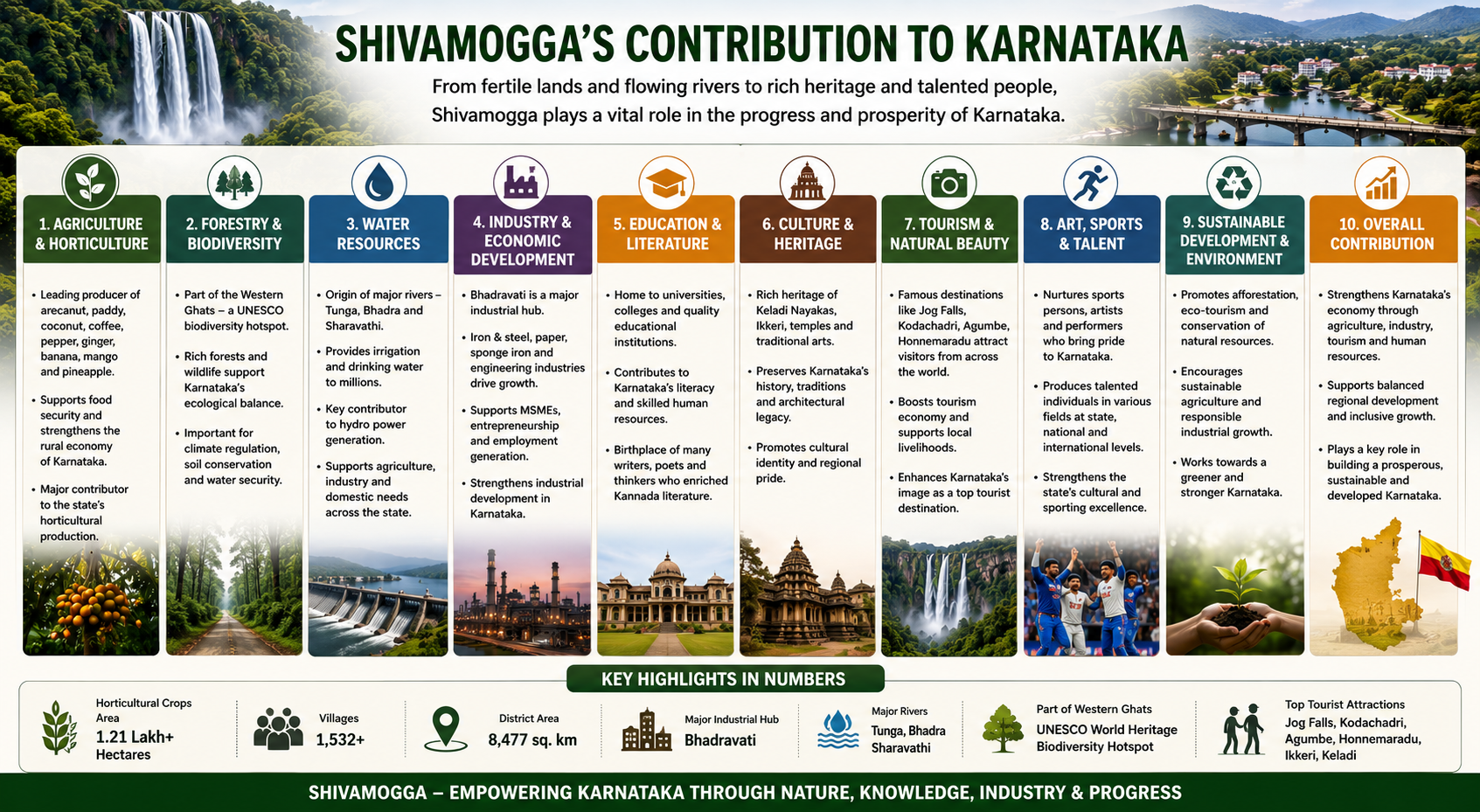
Agriculture remains one of the strongest foundations of the district’s economy. Arecanut, paddy, coconut, coffee, pepper, ginger, banana, mango and pineapple are among the important crops cultivated across different parts of Shivamogga. Horticulture has a particularly significant role: the district’s Horticulture Department reports horticultural crops across approximately 1.21 lakh hectares, accounting for about 43% of the district’s net cultivated area. Malnad areas are especially suitable for plantation and spice crops, while the semi-Malnad regions support fruits, vegetables and other commercial crops.
The agricultural economy is supported by Agricultural Produce Market Committees (APMCs), cooperative societies, processing units, storage facilities and agricultural markets. These systems help farmers market their produce, obtain competitive prices and connect with traders and processing industries. The district’s agricultural development is increasingly focused on mechanisation, improved cultivation practices, irrigation, value addition and better market access.
Industry & Manufacturing
Industrial development forms another important part of Shivamogga’s economy. Bhadravati has historically been one of the district’s major industrial centres, particularly through its iron and steel and paper industries. Alongside established industries, the district has opportunities for food processing, agro-based industries, plantation-product processing, engineering, manufacturing and small-scale enterprises.
The growth of Micro, Small and Medium Enterprises (MSMEs) is particularly important for employment and entrepreneurship. Small businesses and processing units help connect rural agricultural production with urban markets, creating opportunities in manufacturing, packaging, logistics, retail and services. At the national level, MSMEs are recognised as an important source of employment and industrial development, particularly in smaller towns and rural areas.
Shivamogga’s Contribution to Karnataka
Nature • Heritage • Knowledge • Industry • Progress
FREQUENTLY ASKED QUESTIONS (FAQ'S)
Why is Shivamogga called the Gateway to Malnad?
Shivamogga is located between the plains of Karnataka and the Western Ghats and provides an important connection to the greener Malnad region. Its landscape and climate are characteristic of the Malnad area.
What is the historical significance of Shivamogga?
Shivamogga has a long history associated with several South Indian dynasties, including the Kadambas, Chalukyas, Hoysalas and Vijayanagara Empire. The Keladi Nayakas played a particularly important role in shaping the region’s political and cultural heritage.
What is the climate like in Shivamogga?
Shivamogga has a tropical, monsoon-influenced climate. Summers are generally warm, the southwest monsoon brings substantial rainfall, and the period from October to February is generally more pleasant for outdoor activities and tourism.
How does Shivamogga contribute to Karnataka?
Shivamogga contributes significantly through agriculture, horticulture, forestry, water resources, industry, education, tourism, culture and environmental conservation. Its natural and human resources make it an important regional contributor to Karnataka’s development.